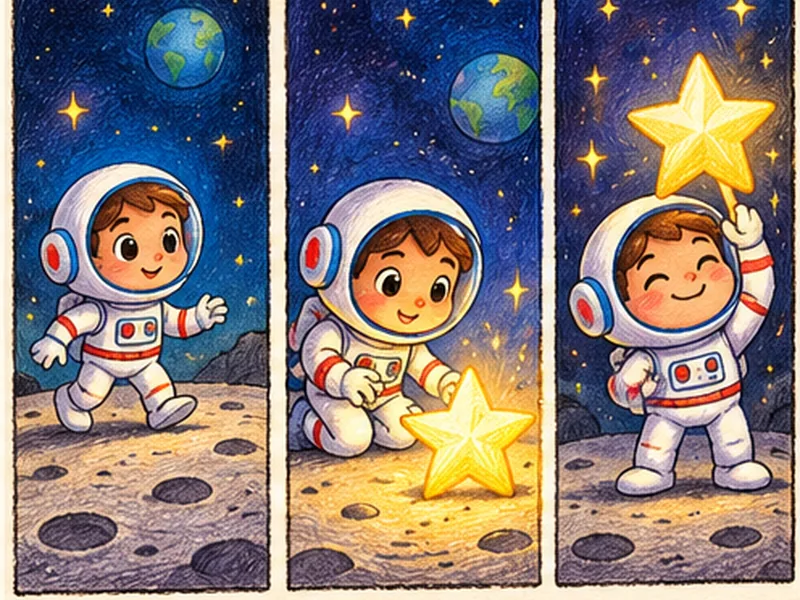
A storyboard is a sequence of pictures that plans what a viewer will see. Begin with a goal, show a problem, and finish with an action.
What you will learn
A storyboard plans what a viewer sees before production begins.
Skills: Story sequence, planning and visual communication
Jump to picture steps ↓What you’ll need
- Paper
- Pencil
- Ruler (optional)
Get ready: Draw three empty boxes and model a beginning, middle and end.
Make it, one picture at a time.
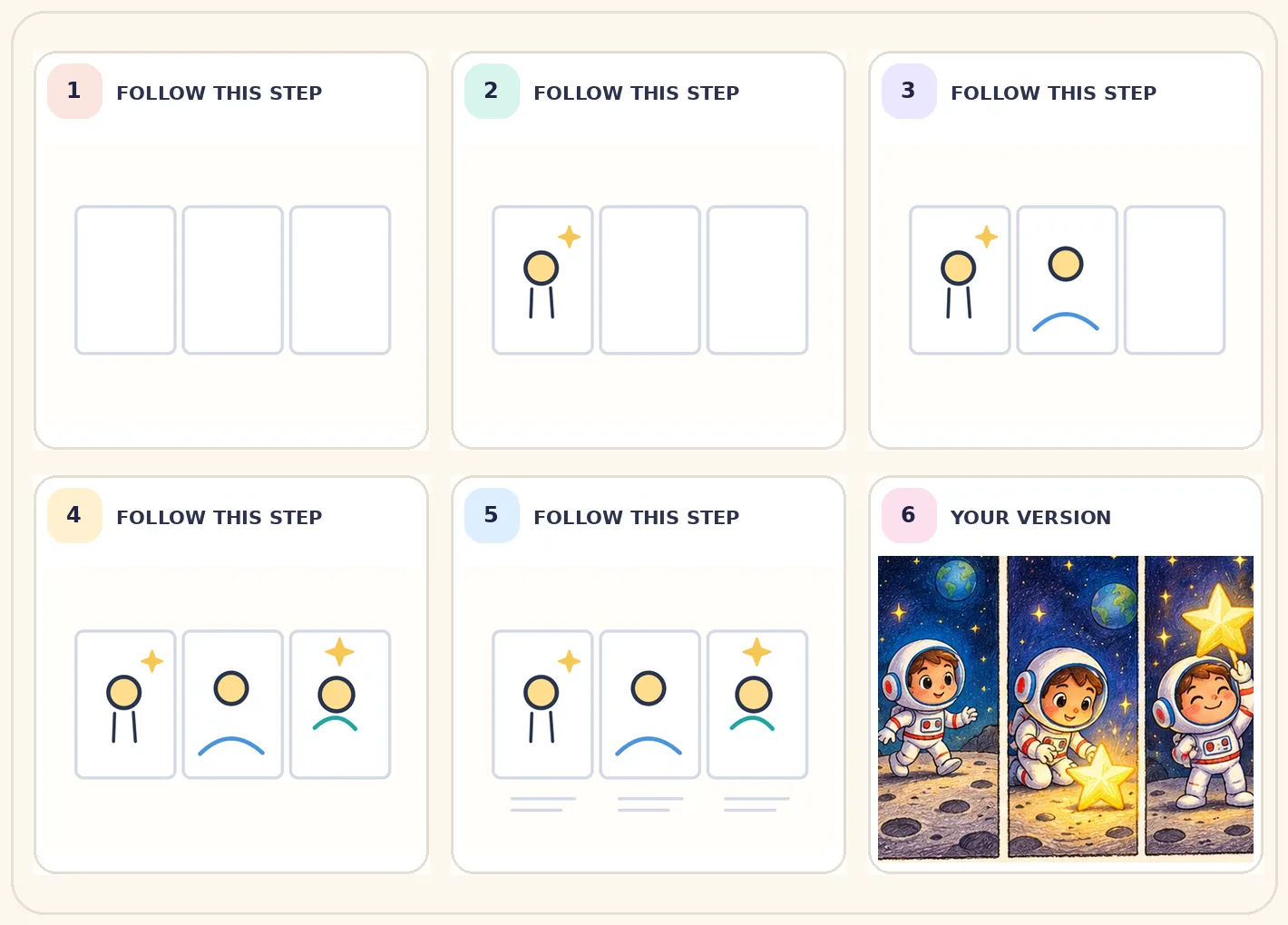
Look at the picture, try that step on your paper, then move to the next. Follow the numbered stages, then choose your own colours and details.
 STEP 01
Divide one sheet into three large boxes.
 STEP 02
In the first box, draw a character with a clear goal, such as reaching a star.
 STEP 03
In the second box, show one obstacle: a puddle, a tall wall or a missing bridge.
 STEP 04
In the final box, draw what the character tries next and how the story ends.
 STEP 05
Below each box, write one short sentence explaining what happens.
Make it your own
Keep the story to one main character and one problem. A simple story is easier to animate later.
Talk about it: Can someone tell your story without reading the sentences?
Help a young artist learn
These practical notes are for parents, carers and teachers. Children can follow the picture steps above.
For parents and carers — teach together
Start together
Draw three empty boxes and model a beginning, middle and end.
During the activity
Ask what the character wants before discussing the ending.
Afterwards
Ask: Can someone tell your story without reading the sentences?
For teachers — classroom adaptation
Learning focus
Story sequence, planning and visual communication
Demonstrate and guide
Let small groups tell the same story using different panels.
Observe, do not grade the artwork
Ask learners to describe one choice they made and one thing they would try differently.
Make it easier or take it further
Make it easier
Use stick figures and arrows.
Extra challenge
Add camera labels such as close-up and wide shot.
Keep creating
Make a bouncing-ball flipbook animation
Animate a bouncing ball on paper, one little drawing at a time.
Create a funny three-panel comic
Practice visual storytelling with a beginning, a surprise and an ending.
Activities are suggestions, not assessments. Adapt materials and supervise as needed.