Poster making combines drawing and graphic design. The goal is not adding as many decorations as possible: it is helping someone quickly understand what the poster says.
Use: Home or classroom · Devices: Not required to start · Reader: Parent, teacher or adult guide
A complete school art-fair poster project
- Collect the facts: Write a sample event name, date, time and audience on scrap paper. Use fictional or teacher-approved details for a practice poster.
- Plan three zones: Divide an A4 page into top (event name), middle (one drawing) and bottom (date, time and place). Do this lightly in pencil.
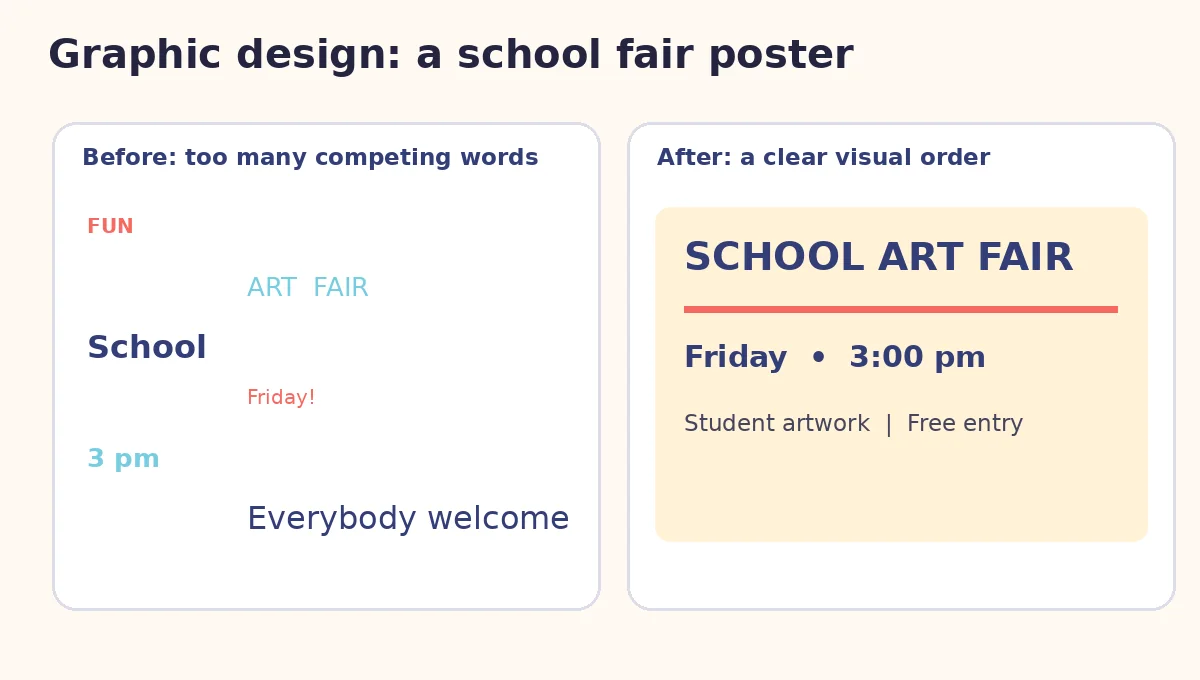
- Make one thing largest: Write “School Art Fair” in the biggest type. Keep the time and date large enough to read from one metre away.
- Choose two main colours: A dark heading and a light background help contrast. Add one illustration that relates to the event.
- Test with another person: Ask them what, when and where. If they cannot answer in five seconds, make the information clearer.
- Make one revision: Compare the first design with a revised design. Explain which change made it easier to understand.
More poster themes for home and school
- Book day: a favourite book and a short invitation to read it.
- Sports day: event name, time and one action drawing.
- Save water: one clear message and a labelled illustration.
- Class exhibition: event title, date and an original student drawing.
Parents and teachers: what to look for
Assess communication, organisation and revisions before artistic polish. A clear handwritten poster can be a better beginner project than an overly complicated computer design. For older learners, recreate the same plan digitally after the paper version works.
Questions parents and teachers ask
What are easy poster making ideas for children?
A book day, sports day or class art exhibition poster is manageable because it has a clear title, one image and a few event details.
Does a child need graphic design software?
No. Start with A4 paper, a pencil and two colours; the principles of hierarchy and contrast work without a screen.
Enjoyed the activity? Explore guided hobby learning.
Free projects are a useful starting point. If your child enjoys practising, Arts Film Academy publishes hobby options in drawing, digital art, animation and coding. Ask the academy about actual class availability, child suitability, teaching approach, sample projects and fees before enrolling.
Explore hobby-class options →Visit Arts Film Academy ↗
Adult enquiries only. AtFunky does not promise higher marks, IQ gains, professional qualifications or future jobs.
Activity ages are approximate and should be adapted to the child. Adult supervision is required where tools, small parts or public settings are involved. Teaching outcomes depend on the activity and guidance, not on a promised score or profession.